
Where AI value hides: between your systems
 Ali Sadreddini
October 8, 2026
10 minutes to read
Most of the organisations I talk to are partway into adopting AI, not at the finish line. A few AI assistants are in people’s hands, a pilot or two has gone well, and a governed AI platform is either on the roadmap or being built right now: identity, data access, guardrails, all the unglamorous work that makes everything else safe. It takes time, and it should.
Nobody wants to stand still while it happens, though, and the questions have changed. A year ago, most conversations started with which model to use and from which provider. I rarely hear that one now: the models are good enough for most work, and most platforms let you swap them as better ones arrive. The question I hear most is which use cases are worth backing first, so that when the platform is ready there’s real value waiting to run on it.
It’s also unlikely to end with one platform. Most organisations will run several AI tools alongside the systems they already depend on, and the job becomes making them work together.
My answer to the use-case question: look between your systems.
Where the value is hiding
Your core systems are not the problem. Your CRM, your ERP, your HR platform, your finance system: each one is built, assured and improved by a vendor whose whole business is getting that one thing right. They do it well.
The problem lives between them. A customer order starts in the CRM, gets priced from a spreadsheet someone built years ago, waits on a credit check from finance, gets scheduled in an operations system and is finally invoiced from the ERP. Every handover is a person re-keying, checking, chasing or emailing. Nobody owns that path end to end, because no single system does.
I call those the seams. They don’t show up on an architecture diagram. They show up in overtime, in the one person who “just knows how it works”, and in the spreadsheet that would stop the business if someone deleted it.
This is also why so many AI programmes stall after a promising first year. The common pattern is to bolt AI onto each step of the process as it stands today: a summary here, a draft there, a chatbot on the side. Each one works. None of them changes the process, and a growing list of disconnected use cases doesn’t add up to much. The tool is the visible part. The value sits underneath, in how the work flows from one system to the next.
How to find your seams
You don’t need a transformation programme to find them. Pick one process that matters, follow it from the first trigger to the last outcome, and count four things:
- how many times someone switches system
- how many times the same information is typed again
- how long the work sits waiting for someone
- where the workaround lives: the spreadsheet, the inbox, the shared drive
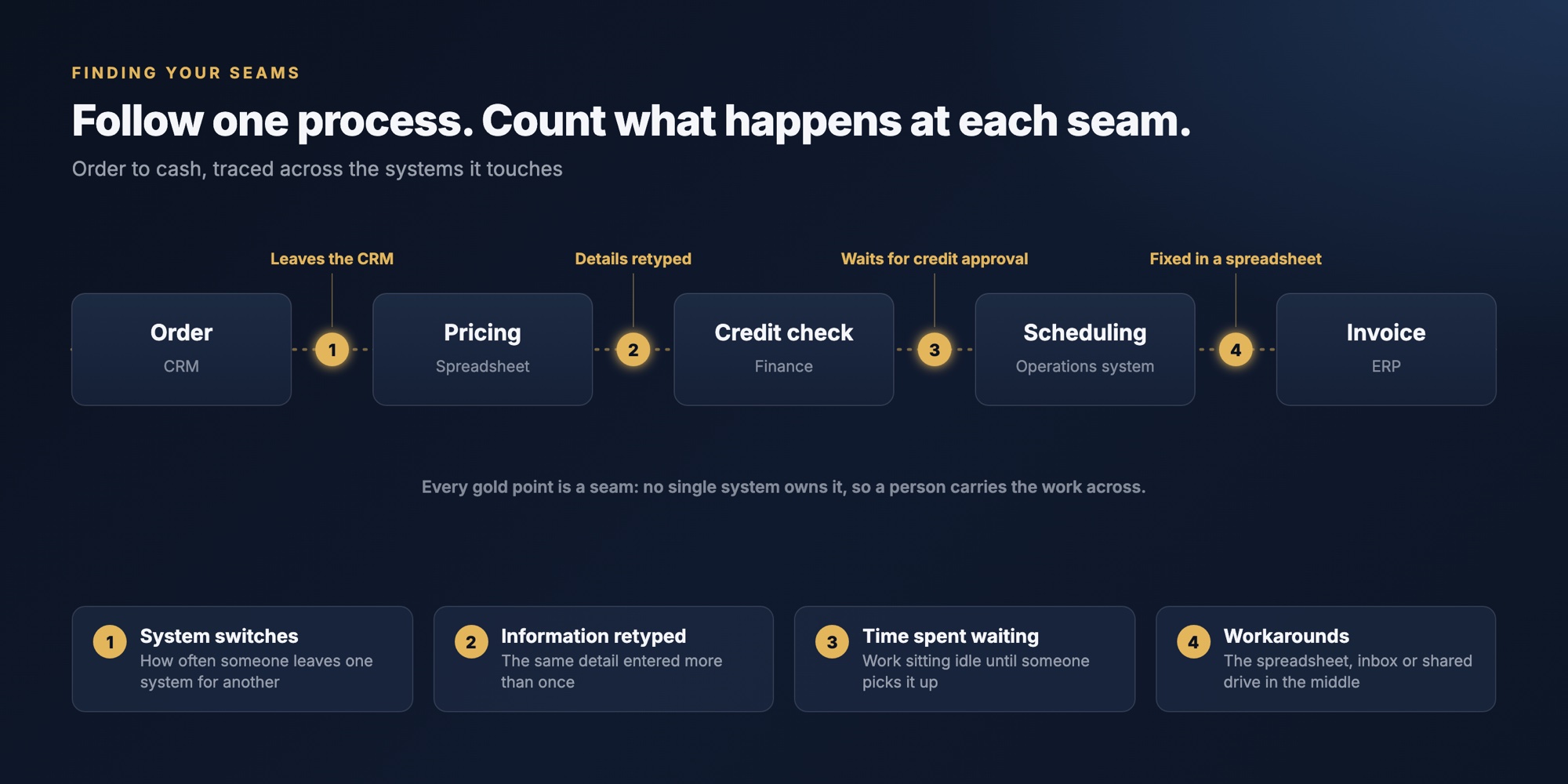
Do that for a week and you’ll have a ranked list. The most expensive seam is rarely the one people complain about loudest. It’s usually the one everyone has quietly learned to live with.
Buy, Build or Blend
Once you’ve found a seam, you have three options.
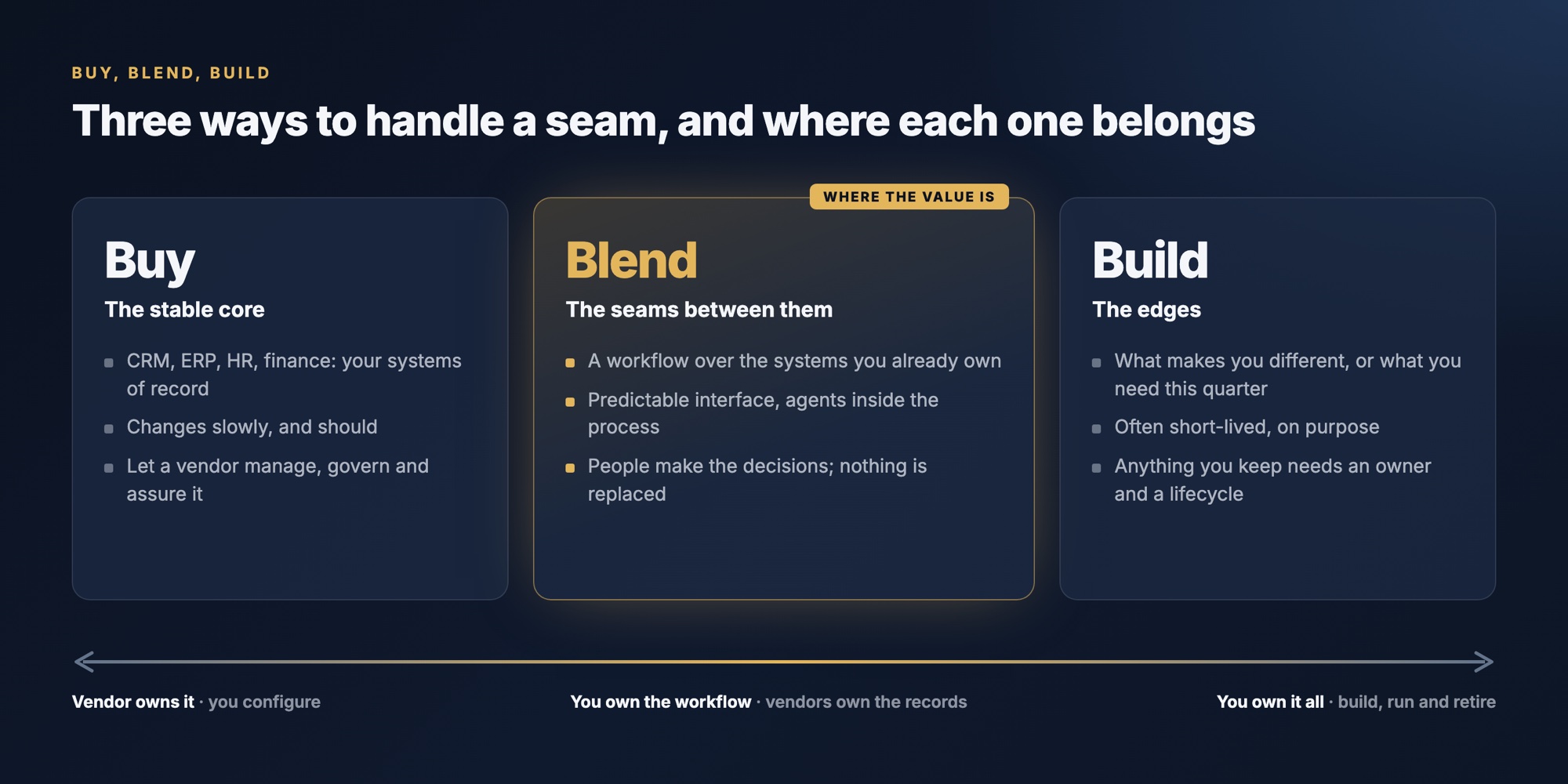
Buy. If the answer is a system of record, keep buying it. Someone else manages, governs and assures it, and that is worth paying for. Agentic tooling makes it tempting to rebuild things you shouldn’t own. Resist that.
Build. Small team and business apps are now quick to produce, whether a developer writes them or an agent does. That’s genuinely useful, and some of them should be short-lived on purpose: built for a quarter, then retired. The risk is the build nobody owns. Cheap to make is not the same as cheap to run, and every app that sticks around becomes something to support, secure and pay for. Anyone who lived through the departmental databases of the early 2000s has seen this film before. Anything you intend to keep needs an owner and a plan for its whole life, from the day it’s built to the day it’s switched off.
Blend. This is the option most organisations don’t have a budget line for: a tailor-made workflow that sits over the systems you already own, shaped around how the work actually happens. Nothing gets migrated and nothing gets replaced. The seam itself becomes the application.
That last one is where I think most of the value from AI will be found over the next few years.
What a blended seam looks like
When it’s done well, a few things tend to be true.
The interface is predictable. People see the same screen and the same steps every time, because a process that changes shape on every run is not one anyone can trust or audit.
The agents work inside the process, not beside it. They pull the customer record from the CRM, check the order against stock and credit, flag the clash in the delivery schedule and summarise what changed since yesterday. Because something can now see the whole process rather than one step of it, some of the handoffs simply disappear. You find the agents’ work where you need it, instead of opening a chat window and asking.
Not every step needs an agent, though. Plenty of what happens in a seam is plain automation: move this, check that, notify them. Use an agent where a step needs judgement and the freedom to act, and use something simpler everywhere else. It’s cheaper and easier to trust.
People make the decisions. The agent prepares and a person approves. That isn’t a concession to a nervous risk team; it’s what makes the whole thing usable in a regulated business.
A few places I’d look first
Almost every organisation has some version of these.
Order to cash. Order, pricing, credit, scheduling and invoicing usually live in four or five systems. Imagine one workflow where the order is checked against stock and credit as it’s taken, scheduled without anyone retyping it, and invoiced from what was actually delivered.
Employee onboarding. HR, IT, facilities, payroll and the hiring manager each hold a piece. Imagine a new starter’s first week assembled from one record, with every request raised and chased for you, and the manager able to see exactly what’s still outstanding.
Field operations. The job sits in one system, the asset history in another, parts in a third and the technician’s notes on their phone. Imagine the technician arriving with the history, the likely fault and the parts already reserved, and their notes flowing back into every system that needs them.
None of these needs a new core system. Each one needs someone to own the seam.
Making it stick
Two things matter more than the technology.
First, let the people closest to the work build. They know exactly where the seam hurts, and more and more technology work is going to happen outside the IT department whether IT plans for it or not. The answer isn’t to stop it. It’s for IT to own the platforms, the approved connectors and the guardrails, so that what gets built is safe by default. Unlock tools by demonstrated competence rather than job title, so the people who can use them well get them quickly and everyone can see what it takes.
Second, avoid the traps. Don’t count licences or use cases as adoption; seats deployed and pilots launched are not work changed. Don’t rebuild a system of record just because you suddenly can. Don’t build the same integration three times for three different projects; build it once and share it. And don’t route every agent through one central approval queue. It becomes a queue rather than control, and people find their way around it.
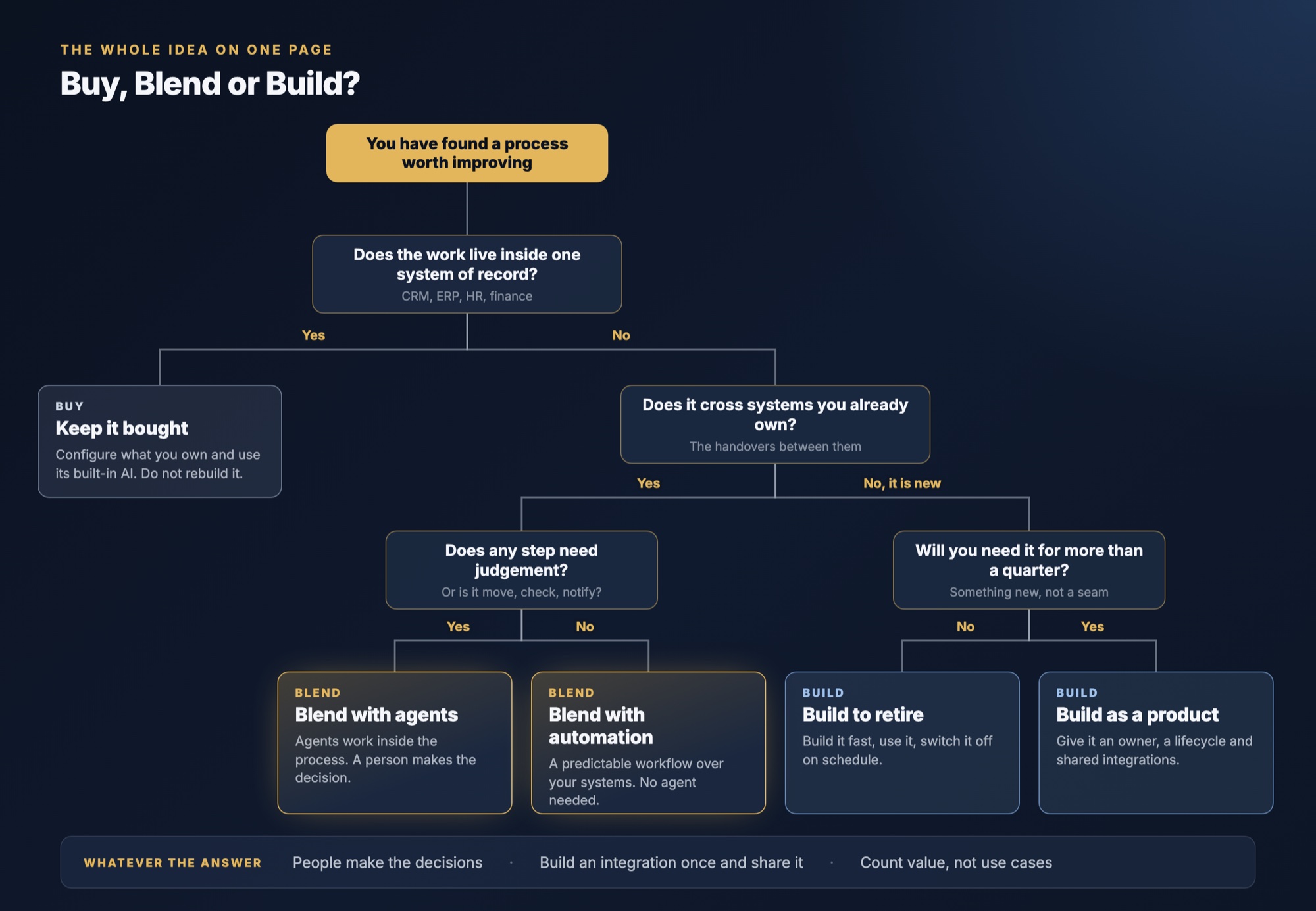
The whole idea on one page
If you take one thing from this, take the order of the questions. Start with the process, not the tool.
How we approached it
At Insight we did this to ourselves first. We started with enablement: giving people the tools and the permission to use them. We moved to the seams once people had the confidence to build. Our own lead-to-revenue process was one of the first. Six systems, none of them replaced, one workflow over the top. We learned more from that than from any slide we’d written about it, including where we’d got the approval model wrong.
So while the platform comes together, don’t wait to decide where it will earn its keep. The use cases worth backing are rarely inside one system. They’re in the seams between them.
Where’s the most expensive seam in your organisation? I’d like to hear.